
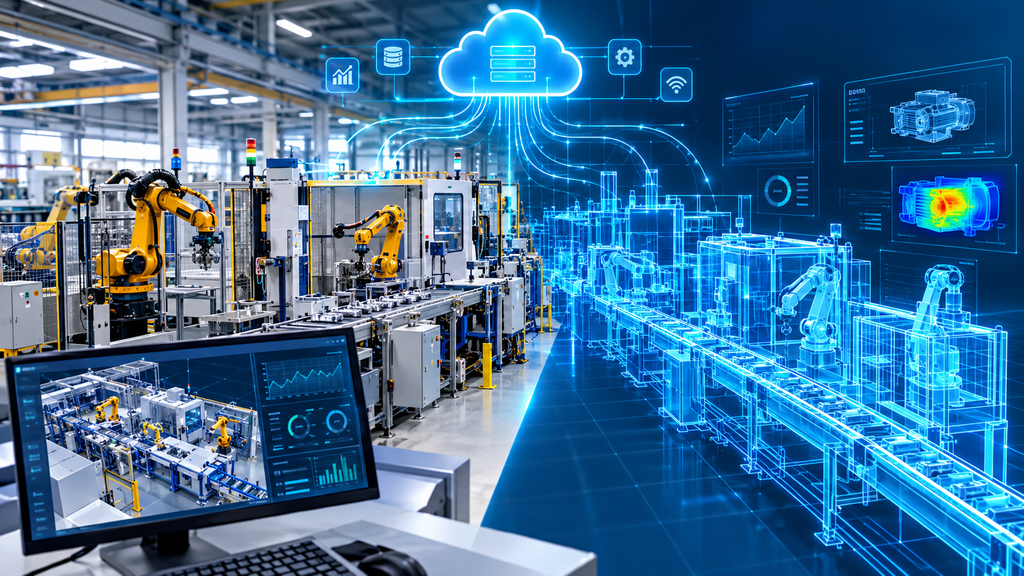
Picture a stamping line copied into software, down to the last conveyor. Engineers move a robot cell on screen, check the cycle time, and only then call the riggers. The same model notices a gearbox running two degrees hotter than last month. Useful? Very. Hooking it up to real machines is another story, and that’s where integrators come in.
Digital Twin Architecture: How to Connect IoT Sensors on the Line to Cloud Analytics Without Stopping Production
Here’s the awkward truth about most factories. The PLCs went in around 2008, SCADA got an upgrade in 2015, and the MES came from a third vendor somewhere in between. Nobody is going to rip all that out for a twin. Nor should they.
Four pieces, roughly:
- Gateways at the edge. These boxes sit in the control cabinet and pull PLC and sensor values over OPC UA or MQTT. They also keep a local buffer. Cloud down for an hour? Fine, the line keeps running and the data waits until the link comes back.
- Read-only access. The twin listens to SCADA tags, and that’s it. Changing a setpoint is still a job for the MES and the operator on shift.
- Heavy lifting in the cloud. Historian, ML models, real-time simulation. All of it runs off-site, on data already cleaned up at the edge.
- One cell first. Weeks of parallel running, numbers side by side, then the next line. Boring, yes. It’s also the reason nothing stops.
Top Digital Twin & Smart Manufacturing Solution Providers
DXC Technology
DXC has been doing factory IT for more than 45 years. Today it manages over 4 million plant production points, plus 300+ environments where downtime simply isn’t an option. Its manufacturing IT services (https://dxc.com/industries/manufacturing) span IT/OT integration, Smart Factory rollouts and MES/PLM upgrades, often all three on one site. One number stands out. At a munitions plant, OEE went up 20%, and on-time delivery improved by 55%.
Key technology focus:
- Industrial IoT and private 5G networks (DXC Signal)
- AI quality checks and Predictive Maintenance
- MES/PLM upgrades via DXC Modernization Studio
Accenture
Accenture’s factory work sits in Industry X. The big move came in 2024, when it set up a joint business group with Siemens around manufacturing software. Before that, it picked up Flutura, an industrial AI company.
Key technology focus:
- Plant and supply chain twins
- Integration of Siemens Xcelerator and other OT platforms
- Industrial AI for asset performance
PTC
PTC is an engineering software house first. Creo for drawing parts, Windchill for keeping product data in order. Vuforia is where it gets practical on the floor, since a technician can point a tablet at a machine and see live twin data over the real equipment.
Key technology focus:
- CAD/CAM integration with Creo and Onshape
- PLM-based digital thread with Windchill
- AR work instructions and field service with Vuforia
IBM
IBM’s answer here is Maximo. It began as asset management software, and now its Monitor and Predict modules use sensor data to estimate which pump or motor is next in line to break. With watsonx on top, a maintenance tech types a question in plain English and gets an answer without hunting through dashboards.
Key technology focus:
- Enterprise asset performance management
- Failure prediction from sensor data
- Deployment on Red Hat OpenShift, on-site or in the cloud
Siemens
Siemens Digital Industries Software has a tool for almost every stage, all under Xcelerator. NX for design. Simcenter and Tecnomatix for simulation. Opcenter for MES. Photorealistic factory twins? Those come through the NVIDIA Omniverse partnership.
Key technology focus:
- Comprehensive twin of product, production and performance
- Virtual commissioning of automation lines
- PLM with Teamcenter, IIoT analytics with Insights Hub
Infosys
Infosys runs its factory projects through Infosys Engineering Services. Product engineering, Industry 4.0, smart factories: the usual list. The more telling detail is the 2024 deal for in-tech, a German engineering firm. That was clearly an automotive play.
Key technology focus:
- Connected factory and IIoT platforms
- Cloud migration through Infosys Cobalt
- AI-based analytics with Infosys Topaz
Dassault Systèmes
Dassault Systèmes won’t call it a digital twin. Its word is “virtual twin.” Naming aside, everything sits on 3DEXPERIENCE: CATIA for design, SIMULIA for simulation, DELMIA for the shop floor and labor planning.
Key technology focus:
- Virtual twins of products and factories
- Multiphysics simulation with SIMULIA
- Production planning and MES with DELMIA
Cognizant
Cognizant handles IoT, OT and engineering work for both discrete and process plants. In 2024, it bought Belcan. Why does that matter? Belcan came with thousands of engineers who know aerospace and defense.
Key technology focus:
- Connected-plant and IIoT integration
- Engineering and R&D services through Belcan
- Data platforms for Predictive Maintenance
Capgemini
Capgemini doesn’t sell its own twin platform, and for some buyers that’s actually a plus. Projects go through Capgemini Engineering (the former Altran) and Intelligent Industry, usually on top of Dassault, Siemens or a hyperscaler.
Key technology focus:
- Twins for R&D and plant operations
- IT/OT convergence and private 5G for factories
- Energy and sustainability analytics
Wipro
Wipro’s engineering arm, Wipro Engineering Edge, does product engineering and industrial IoT for carmakers, equipment builders and consumer goods brands. AI gets layered in through the ai360 program.
Key technology focus:
- Smart factory and IIoT implementation
- Twins for asset and process monitoring
- PLM and engineering services
Quick Overview Table
| Company | Key technology stack | Digital twin specialization | Geography |
| DXC Technology | Industrial IoT, edge-to-cloud, Private 5G, MES/PLM, SAP | Predictive Maintenance, smart factory analytics | Global, HQ in the USA |
| Accenture | Siemens Xcelerator, industrial AI, cloud platforms | Plant and supply chain twins | Global, HQ in Ireland |
| PTC | Creo, Onshape, Windchill, Vuforia | Product twins and digital thread | Global, HQ in the USA |
| IBM | Maximo, watsonx, Red Hat OpenShift | Asset performance twins | Global, HQ in the USA |
| Siemens | NX, Simcenter, Tecnomatix, Opcenter, Teamcenter | Product, production and performance twins | Global, HQ in Germany |
| Infosys | Infosys Cobalt, Infosys Topaz, IIoT | Connected factory and engineering twins | Global, HQ in India |
| Dassault Systèmes | 3DEXPERIENCE, CATIA, SIMULIA, DELMIA | Virtual twins of products and factories | Global, HQ in France |
| Cognizant | IIoT, OT services, Belcan engineering | Connected plant and R&D twins | Global, HQ in the USA |
| Capgemini | Capgemini Engineering, private 5G, cloud | R&D and plant operations twins | Global, HQ in France |
| Wipro | Wipro Engineering Edge, ai360, IIoT | Asset and process monitoring twins | Global, HQ in India |
How to Stress-Test a Digital Twin Before Integrating It into a Live Production Process
On clean historical data, almost every model looks great. Then at 3 a.m. a temperature probe on line 2 starts drifting, half a degree an hour. Does the twin notice? Or does it calmly recommend slowing the line down?
Five checks catch most of this before go-live:
- Replay history. Feed in several months of historian data. Compare predicted output, energy use and failures with what really happened.
- Break the inputs on purpose. Dropouts, noise, frozen values, a pressure reading of minus 40 bar. A decent twin flags it. A bad one uses it.
- Push it to the limits. Peak throughput. Product changeovers. Cold starts after a long weekend. That’s where models usually start to slip.
- Pull the plug. Literally cut the cloud link. The edge buffer should hold, and nothing odd should reach SCADA.
- Shadow mode. Several weeks next to the real line, recommendations only. No closed-loop control until the numbers match.
Sounds slow? It is. Still cheaper than a stopped line.
So, Who Does What?
Honestly, the 3D model is rarely the problem. Wiring it into a plant is. Siemens, PTC and Dassault Systèmes make the modeling and real-time simulation software, while the others on this list, from DXC to Wipro, hook it up to the PLCs, MES and ERP a site already has. What should decide the pick? Mostly OT experience and a rollout plan that doesn’t overpromise. Plus one line that already runs on the twin.
FAQ
Is a digital twin just another simulation? A simulation runs on assumptions. A twin gets its numbers from the machine itself, live.
Is the cloud a must? No. Time-critical models often run right next to the line, and the cloud is used for training and the archive.
How soon are the first results? A single-line pilot usually takes a few months. Scaling to the whole plant is slower, and old systems with messy data are usually the reason.